|
|
by
Menno Wielinga, translation by Guido Blokland
On 11th October 1914, 1,500 men of the First Royal Naval Brigade arrived in Groningen. They had been deployed in early October to assist the Belgian army against German troops attacking
Antwerp.
During their retreat in Belgium, their escape route was cut off. Commodore Wilfred Henderson was determined for his men not to be taken prisoner of war by the
Germans, so he crossed the frontier into Holland with three of his
batallions.
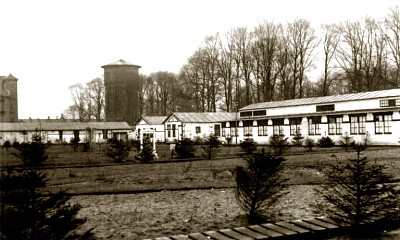 |
| Photograph of the barracks with to the left in the background the prison and the
watertower. |
On arrival in Holland, they were interned (in accordance with International Law), in Groningen, a city in northern Holland. Behind the present-day Mesdagkliniek (the former city jail) a complete encampment was erected on the paradeground of the Rabenhauptkazerne (the local military barracks, situated opposite this prison).
The camp had many facilities for sports, housing, healthcare, security and
relaxation. This camp quickly acquired the local nickname of “Engelse Kamp” (English Camp). The
British themselves called the camp 'Timbertown' or 'HMS Timbertown'.
 Internment of British militaries at Groningen 1914-1918 Internment of British militaries at Groningen 1914-1918
Guido
Blokland - HMS TIMBERTOWN -
British service personnel of
the Isle of Lewis interned in Groningen during the Great
War 1914 - 1918
War graves
from the Great War on the Zuiderbegraafplaats in Groningen
The First Royal Naval Brigade was part of the Royal Naval
Division. If you want to know more about the Royal Naval Division
read the article written by Eric R.J. Wils:
 The
(63rd) Royal Naval Division - Sailors in the First World War
trenches
The
(63rd) Royal Naval Division - Sailors in the First World War
trenches
Originally, this division was part of the Royal Navy,
manned by sailors and marines. Shortly after the
outbreak of war, they were told they had to become
infantry-men. A search for traces of this division leads
to Antwerp, Gallipoli, the Somme, Arras, Passchendaele,
to end in London.
 Book published about the English Camp
Het Engelse Kamp –
Groningen 1914 -1918
This book is a unique report about the
internment of 1.500 British sailors in the city of Groningen
during the Great War. Life in the Camp in all its facets has been
reconstructed using newspaper, literature, diaries, reports,
letters, contact with descendants from internees. The book has
about 300 pages and more than 270 historical photographs. The book
contains a DVD with a film documentary by director Leo van Maaren
about the Timbertown Follies - the ‘funny British cabaret company’
which was very successful and acquired national publicity.
Through interviews with Dutch music experts a forgotten episode in Dutch music history
is being brought back to life. Retail price 32.95 euro.
You can order the book
by email to
info@profiel.nl
■■
Please include your full name and address at the order.
■■ NB.
The book is in Dutch with a summery in English.
|
The story of the Britons in Groningen can be read in this series of
articles, which were originally published in the regional newspaper 'Nieuwsblad van het Noorden'. All
articles are translated by Guido Blokland.
| |
Although
the book is published now I
am still looking
for more
information about the English Camp.
Every detail, anecdote, photograph or personal memory is
useful for my research. Do not hesitate to e-mail me! Please send reactions to Menno Wielinga:
|
| |
If you are interested in the Royal Naval Division may be you are
intersted in the 24 part history of the Royal Naval Brigade the
R.N.D. written by Leonard Sellers extending to 2,433 pages
plus 3 indexes ended 9 years ago. It has now become
available on 1 CD.
Click here to have a look on EBay. |
Part 1
'Saturday afternoon soldiers' called upon to save Antwerp
Part 2 The First Brigade is forgotten in the evacuation of Antwerp
Part 3
Large groups of Groningers stare at us through the fences
Part 4 British complain of poor food
Part 5 Boredom the biggest enemy of interned Britons
Part 6 British were popular with the women
Part 7 British football at high level
Part 8 Internees taken prisoner of war during compassionate leave
Part 9 State of Siege declared in Groningen
Part 10 The escape by John Henry Bentham (1)
Part 11 The escape by John Henry Bentham (2)
Part 12 Nine British servicemen lie buried at Groningen
Part 13 The English Camp in Groningen 1919-1958
to homepage of website wereldoorlog
1914-1918
|
|
